











Men with low testosterone often face a difficult choice: take exogenous testosterone and risk fertility loss, or use hormone modulators that preserve their ability to conceive. Two drugs, clomiphene citrate (a racemic mixture) and its purified isomer enclomiphene, have emerged as fertility-friendly options. In this post, we compare their mechanisms, effectiveness, safety, and practical use for male hormone health.
Low testosterone can affect energy, mood, and fertility, but not all treatments are created equal. At Vita Bella, we believe in science-backed, fertility-friendly solutions that help men naturally restore balance. Both enclomiphene and clomiphene are transforming hormone health by boosting testosterone without compromising fertility.
What are the Mechanism and Pharmacokinetics of Enclomiphene and Clomiphene?
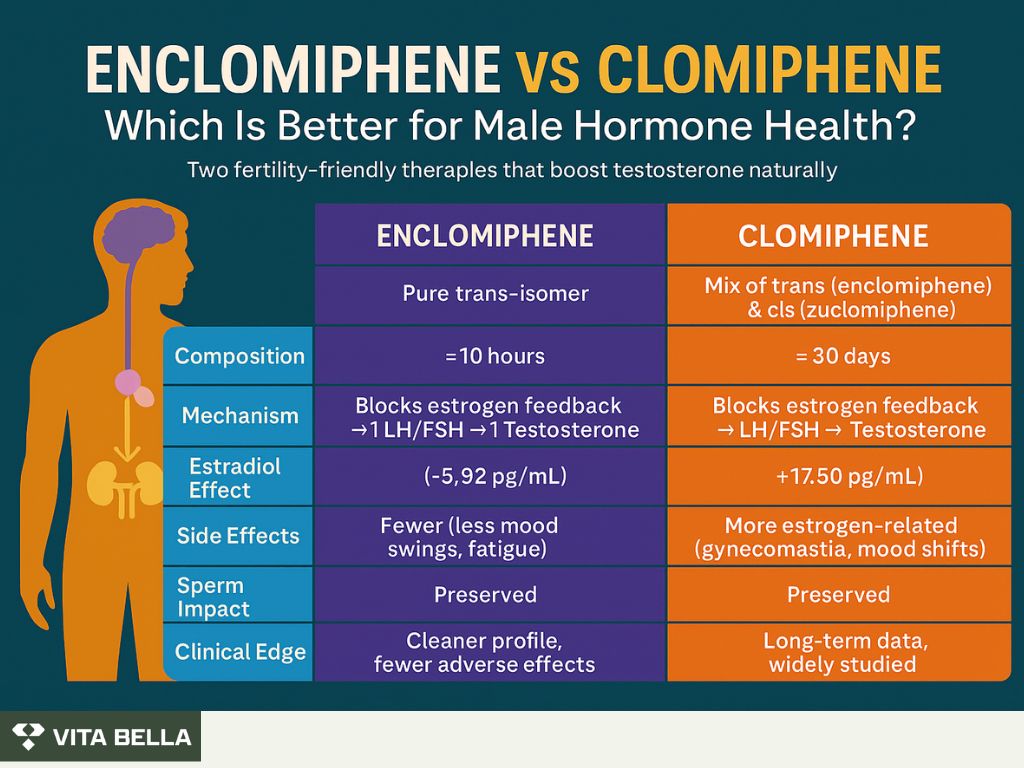
Clomiphene is a racemic mixture composed of enclomiphene (trans isomer) and zuclomiphene (cis isomer), the latter having more estrogenic effects and a long half-life of ~30 days. In contrast, enclomiphene has a half-life around 10 -- 10.5 hours and lacks the persistent estrogenic influence of zuclomiphene.
Both drugs block estrogen feedback at the hypothalamus and pituitary, increase LH/FSH, and thus boost natural testosterone production while preserving sperm production. By omitting the zuclomiphene component, enclomiphene 1 may avoid some of clomiphene’s side effects while providing a more refined pro-gonadotropic stimulus.
Efficacy: How Strong Are the Hormone Gains?
Both compounds significantly increase testosterone levels; however, some head-to-head data suggest that enclomiphene might have a modest edge in specific hormonal parameters.
In a retrospective study 2 with 66 men who switched from clomiphene to enclomiphene, enclomiphene produced a median testosterone increase of 166 ng/dL vs. 98 ng/dL with clomiphene (P = 0.20). Significantly, estradiol changes were lower with enclomiphene (–5.92 vs. +17.50 pg/mL, P = 0.001). Also, documented adverse effects (loss of libido, reduced energy, mood changes) were significantly less frequent under enclomiphene (OR 0.18, 95% CI 0.07 -- 0.44, P = 0.02).
In a separate retrospective cohort 3 comparing 46 men on enclomiphene vs 32 on clomiphene, both groups saw significant rises in total testosterone. However, only the enclomiphene group demonstrated statistically significant increases in LH & FSH. Sperm motility improved in both, but total motile sperm count (TMSC) rose significantly only in the enclomiphene arm (p < 0.05).
Thus, enclomiphene may offer more substantial support to gonadotropins while achieving comparable testosterone gains.
What are their Safety and Side Effect Profiles?
Enclomiphene lacks the longer-acting estrogenic isomer, it may carry a lower risk of estrogenic adverse effects, making it a more tolerable option for many men. Both drugs are generally well tolerated in men, but enclomiphene may yield fewer adverse events:
In the retrospective switch study 2 (66 patients), adverse events such as reduced libido, fatigue, or mood changes occurred significantly less often with enclomiphene (P values: 0.001, 0.044, 0.03).
The Journal of Sexual Medicine comparative review 1 notes that enclomiphene avoids many estrogenic side effects attributed to zuclomiphene, such as mood swings and gynecomastia.
What are the Advantages and Limitations of enclomiphene over clomiphene in Practical Use?
Enclomiphene offers more targeted action with a shorter half-life and fewer estrogen-related side effects, leading to more stable testosterone and gonadotropin levels. However, its limitation lies in having less long-term clinical data compared to clomiphene, which has decades of established use and broader research support.
More targeted action (no zuclomiphene load)
Shorter half-life, thus less accumulation
Comparable testosterone gains with lower estradiol elevation
Lower incidence of side effects documented in retrospective comparisons
However, clomiphene has decades of experience and a larger body of safety and fertility data, especially in cases of idiopathic male infertility. Clomiphene’s long track record 4 in improving sperm parameters is especially appealing in fertility settings.
Thus, clomiphene remains a solid, well-understood option, while enclomiphene offers a newer, potentially improved alternative, especially when concerns about side effects or estrogenic issues arise.
What are the monitoring recommendations?
During enclomiphene or clomiphene therapy, regular monitoring of testosterone, LH, FSH, and estradiol is essential every 3–6 months to ensure optimal hormone balance. Semen analysis, hematocrit, and liver function tests should also be evaluated periodically to track fertility outcomes and detect any early side effects.
Begin with a moderate dose (e.g. 12.5–25 mg daily), assess response at 3, 6, and 12 months
Check total + free testosterone, LH, FSH, estradiol, hematocrit, and semen parameters
Watch for estrogenic symptoms (especially under clomiphene)
If side effects arise on clomiphene, switching to enclomiphene may reduce complaints without losing efficacy
Low Testosterone Is a Challenge but not the End of Your Story.
Hormonal imbalance can affect every aspect of life, but the right approach can change everything. At Vita Bella, we combine science and care to help men rediscover balance through targeted treatments, such as enclomiphene and clomiphene. These evidence-based therapies work with your body’s natural processes to restore testosterone and energy. With the proper guidance, reclaiming your confidence and hormone health is entirely within reach.
FAQs
What is the main difference between enclomiphene and clomiphene?
Clomiphene is a mixture of two isomers, enclomiphene and zuclomiphene, while enclomiphene contains only the active trans isomer. This makes enclomiphene more targeted, shorter-acting, and less likely to cause estrogen-related side effects such as mood swings or gynecomastia.
Can both enclomiphene and clomiphene improve fertility in men?
Yes, both drugs increase testosterone by stimulating natural hormone production without suppressing sperm formation. This makes them ideal for men who want to boost testosterone while preserving or improving fertility potential.
Which treatment works faster for improving testosterone levels?
Studies show that both therapies raise testosterone effectively, but enclomiphene may achieve more stable levels with fewer estrogen fluctuations due to its shorter half-life and cleaner pharmacological profile.
Are these treatments safe for long-term use?
Yes, when monitored by a qualified healthcare professional, both enclomiphene and clomiphene are considered safe and well-tolerated. Regular follow-ups help ensure hormone levels, blood parameters, and fertility remain within optimal ranges.
Reference:
Kassab, J., Saffati, G., Lipshultz, L., & Khera, M. (2024). Safety and Efficacy of Enclomiphene Compared to Clomiphene for Hypogonadal Men (Journal of Sexual Medicine, 21 Supplement_1, qdae001.090). https://doi.org/10.1093/jsxmed/qdae001.090
Saffati, G., Kassab, J., Orozco Rendon, D., Hinojosa-Gonzalez, D. E., Kronstedt, S., Lipshultz, L. I., & Khera, M. (2024). Safety and efficacy of enclomiphene and clomiphene for hypogonadal men. Translational Andrology and Urology, 13(9). https://doi.org/10.21037/tau-24-238
Thomas, J., Suarez Arbelaez, M. C., Narasimman, M., Weber, A. R., Blachman-Braun, R., White, J. T., Ledesma, B., Ghomeshi, A., Jara-Palacios, M. A., & Ramasamy, R. (2023). Efficacy of Clomiphene Citrate Versus Enclomiphene Citrate for Male Infertility Treatment: A Retrospective Study. Cureus, 15, e41476. https://doi.org/10.7759/cureus.41476
Huijben, M., Huijsmans, R. L. N., Lock, M. T. W. T., de Kemp, V. F., de Kort, L. M. O., & van Breda, J. H. M. K. (2023). Clomiphene citrate for male infertility: A systematic review and meta-analysis. Andrology, 11(6), 987–996. https://doi.org/10.1111/andr.13388