








When constant soreness, fatigue, or digestive imbalance interfere with your energy, it’s a sign that your body’s natural repair systems are under strain. Many people search for advanced yet natural solutions to help the body heal more efficiently. One compound gaining attention in this field is Pentadeca Arginate (PDA) 1, a next-generation peptide derived from the well-studied BPC-157 family.
Curious about the latest breakthroughs in regenerative wellness? Vita Bella brings you the complete guide to Pentadeca Arginate (PDA), a clinically inspired peptide designed to enhance recovery, repair tissues, and fortify gut health through advanced, research-based support. Learn how PDA supports your body’s natural healing power and discover why it’s becoming a favorite among health enthusiasts.
What is PDA and Its Connection to BPC-157?
PDA is a modified version of BPC-157, a 15-amino-acid peptide known for its tissue-protective and regenerative potential. In human-relevant studies 2, BPC-157 has demonstrated strong cytoprotective and angiogenic properties, meaning it helps stimulate new blood vessel growth and protects cells from oxidative stress.
This regenerative capacity may translate into better healing outcomes for muscle, tendon, and gut tissues. PDA’s arginate form is designed to improve peptide stability, allowing the body to absorb and utilize it more effectively.
What are the benefits of Pentadeca Arginate (PDA)?
Pentadeca Arginate (PDA) may help accelerate muscle and tissue recovery, strengthen gut lining integrity, and reduce inflammation for overall wellness. By enhancing cellular repair and promoting angiogenesis, it naturally and effectively supports faster healing, better digestion, and improved energy balance.
1. Recovery and Tissue Repair
Recovery after injury or intense physical activity depends on efficient cell regeneration and proper blood flow. Evidence from human and clinical models 3 of BPC-157 indicates significant improvements in soft-tissue recovery through enhanced angiogenesis and modulation of nitric oxide (NO) pathways.
By increasing nutrient and oxygen delivery to injured areas, BPC-157 and, by extension, PDA may help shorten recovery time and reduce inflammation. The peptide’s regulatory effect on gene expression linked to tissue regeneration further supports its potential role in restoring muscle, tendon, and ligament integrity.
2. Gut Health and Mucosal Protection
Digestive health lies at the heart of overall wellness, influencing everything from nutrient absorption to immune balance. In human-focused research 4, BPC-157 has shown notable benefits for gastrointestinal repair by accelerating mucosal regeneration and preventing gut barrier dysfunction.
This is crucial because a compromised gut lining allows toxins and bacteria to enter the bloodstream, triggering inflammation and fatigue. PDA, as a more stable derivative, may help reinforce gut integrity, protect against NSAID-induced irritation, and promote smoother digestion.
3. Anti-Inflammatory and Systemic Healing
Inflammation is a natural response, but chronic inflammation slows recovery and increases oxidative stress. Studies 5 have shown that pentadecapeptides like BPC-157 reduce pro-inflammatory cytokines such as TNF-α and IL-6, helping balance immune signaling while promoting tissue repair. The same pathways may apply to PDA, supporting systemic recovery and reducing lingering soreness. This regulatory effect on the inflammatory cascade could explain why many users report feeling less stiffness and more resilience over time.
4. Gut–Brain Axis and Neurological Support
Emerging research 1 highlights a strong connection between gut health and brain performance, known as the gut-brain axis. Pentadecapeptides like BPC-157 have demonstrated neuroprotective properties that may reduce neural inflammation and promote cognitive balance. By supporting gut barrier strength, PDA could indirectly influence mood, focus, and energy levels through improved gut–brain signaling.
This holistic benefit distinguishes PDA from traditional supplements, making it a promising tool for integrated recovery and mental health.
What are the Safety concerns and Human Application of Pentadeca Arginate (PDA)
Safety is a critical consideration in any peptide therapy. Studies 6 suggest that BPC-157 has a favorable safety profile, with minimal adverse effects observed in early human use and translational research. However, because PDA itself has not yet been tested in controlled human trials, it should be viewed as an investigational compound. Responsible use under professional guidance is essential, and long-term effects remain to be studied. The key applications include:
PDA may enhance tissue recovery by improving angiogenesis and cellular repair signaling.
It supports gut health through potential reinforcement of mucosal barriers.
Anti-inflammatory effects may help reduce soreness and accelerate healing.
Gut–brain benefits could promote both physical and cognitive balance.
Human trials are still needed to confirm safety, dosing, and long-term impact.
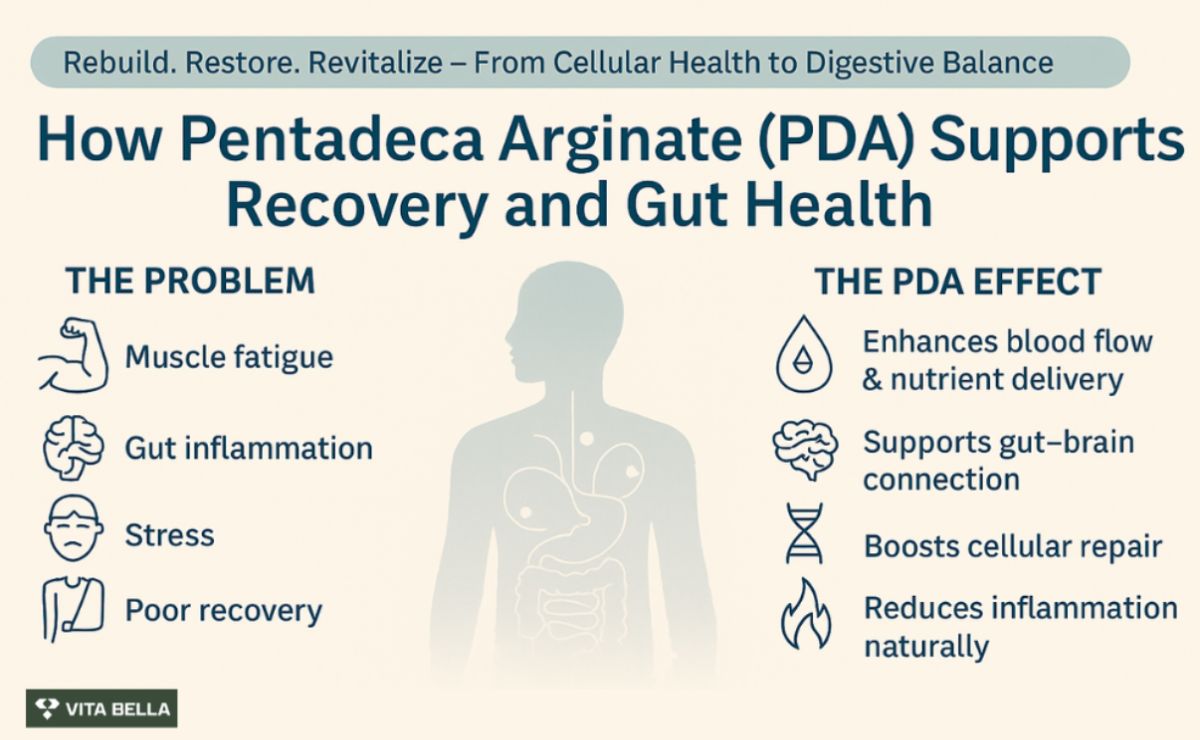
From Fatigue to Flourish: Elevate Your Recovery with PDA
Tired of lingering soreness, fatigue, or bloating disrupting your daily rhythm? Persistent stress, poor recovery, and digestive imbalance can quietly drain your energy and motivation. You’re not alone; your body is asking for support.
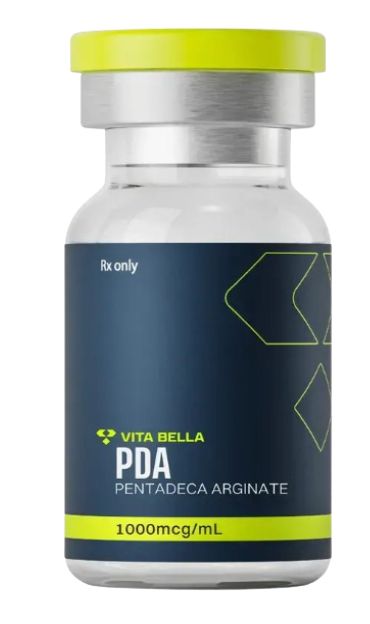
Vita Bella’s Pentadeca Arginate (PDA) helps reignite your system’s natural repair process, restoring energy, balance, and confidence from within. With consistent use, it supports deep cellular recovery and optimal gut health, helping you feel renewed, resilient, and ready to thrive.
FAQs
Is Pentadeca Arginate (PDA) effective for muscle and tissue recovery?
Yes, early reports and practitioner-led case observations suggest that Pentadeca Arginate may promote faster recovery by supporting angiogenesis and enhancing growth hormone receptor expression, which could improve nutrient delivery to injured tissues. However, its effectiveness in humans lacks validation through large, peer-reviewed clinical trials, so results remain preliminary.
Can Pentadeca Arginate improve gut health and digestion?
Yes, PDA is believed to help strengthen the gut lining and reduce inflammation, potentially supporting digestive balance and minimizing intestinal permeability (leaky gut). It may protect mucosal tissues against stress and NSAID-related damage. Still, these effects are primarily theoretical since human trials have not yet confirmed them.
Is Pentadeca Arginate safe for long-term use?
No, there is no definitive evidence yet, but PDA appears well tolerated in short-term clinical practice reports; however, no controlled human studies have established its long-term safety profile. Potential unknowns include cumulative effects, immune modulation, or interactions with medications, so medical supervision is recommended before extended or repeated use.
Does the FDA approve Pentadeca Arginate for medical use?
No, PDA is not FDA-approved for any therapeutic indication. It is available only through compounding pharmacies or specialized wellness clinics. Its use falls under research or off-label categories, meaning consumers should approach it cautiously and consult qualified healthcare providers before beginning supplementation or injection protocols.
References:
Vukojević, J., Milavić, M., Perović, D., Ilić, S., Čilić, A. Z., Đuran, N., Štrbe, S., Zoričić, Z., Filipčić, I., Brečić, P., Seiverth, S., & Sikirić, P. (2022). Pentadecapeptide BPC 157 and the central nervous system. Neural Regeneration Research, 17(3), 482–487. https://doi.org/10.4103/1673-5374.320969
Sikiric, P., Gojkovic, S., Krezic, I., Smoday, I. M., Kalogjera, L., Zizek, H., Oroz, K., Vranes, H., Vukovic, V., Labidi, M., Strbe, S., Baketic Oreskovic, L., Sever, M., Tepes, M., Knezevic, M., Barisic, I., Blagaic, V., Vlainic, J., Dobric, I., & Staresinic, M. (2023). Stable gastric pentadecapeptide BPC 157 may recover brain–gut axis and gut–brain axis function. Pharmaceuticals, 16(5), 676. https://doi.org/10.3390/ph16050676
Sikiric, P., Seiwerth, S., Rucman, R., Kolenc, D., Batelja Vuletić, L., Drmić, D., Grgić, T., Strbe, S., Zukanović, G., & Crvenković, D. (2016). Brain-gut axis and pentadecapeptide BPC 157: Theoretical and practical implications. Current Neuropharmacology, 14(8), 857–865. https://doi.org/10.2174/1570159X13666160502153022
Chang, C.-H., Tsai, W.-C., Hsu, Y.-H., & Su Pang, J.-H. (2014). Pentadecapeptide BPC 157 enhances the growth hormone receptor expression in tendon fibroblasts. Molecules, 19(11), 19066–19077. https://doi.org/10.3390/molecules191119066
Sikiric, P., Hahm, K.-B., Boban Blagaic, A., Tvrdeic, A., Horvat Pavlov, K., Petrovic, A., Kokot, A., Gojkovic, S., Krezic, I., Drmic, D., Rucman, R., & Seiwerth, S. (2020). Stable gastric pentadecapeptide BPC 157, Robert’s stomach cytoprotection/adaptive cytoprotection/organoprotection, and Selye’s stress coping response: Progress, achievements, and the future. Gut and Liver, 14(2), 153–167. https://doi.org/10.5009/gnl18490154
Sikiric, P., Boban Blagaic, A., Strbe, S., Beketic Oreskovic, L., Oreskovic, I., Sikiric, S., Staresinic, M., Sever, M., Kokot, A., Jurjevic, I., Matek, D., Coric, L., Krezic, I., Tvrdeic, A., Luetić, K., Batelja Vuletić, L., Pavic, P., Mestrovic, T., Sjekavica, I., & Skrtic, A. (2024). The stable gastric pentadecapeptide BPC 157 pleiotropic beneficial activity and its possible relations with neurotransmitter activity. Pharmaceuticals, 17(4), 461. https://doi.org/10.3390/ph17040461
QUICK SUMMARY:
Here are the key takeaways about Pentadeca Arginate (PDA) from the document:
What is PDA? It's a "next-generation peptide" that's basically a souped-up, more stable version of the well-known peptide BPC-157.
The Big Benefits: It's mainly hyped for two things:
Helping you recover faster from workouts or injuries.
Majorly boosting your gut health.
How it Works (Recovery): PDA and its parent BPC-157 are thought to speed up healing by:
Getting new blood vessels to grow (angiogenesis), which delivers more oxygen and nutrients to damaged tissues.
Helping to repair muscles, tendons, and ligaments.
Knocking down inflammation, so you feel less sore.
How it Works (Gut Health): PDA is a champion for your digestive system because it may:
Help strengthen your gut lining (crucial for preventing "leaky gut").
Protect your stomach tissues from damage, like the kind caused by NSAIDs.
The Brain Connection: It might even help your mood and focus by supporting the gut-brain axis—the link between your digestive system and your brain.
Safety Check: This is important!
The original BPC-157 looks pretty safe in early research.
BUT PDA itself is still an investigational compound—it hasn't gone through controlled human trials yet.
It's not FDA-approved for medical use.
If you're thinking about trying it, you absolutely need to talk to a qualified healthcare provider first. Long-term effects are still unknown.
The Bottom Line: It's a promising peptide for better recovery and digestion, but right now, its benefits are mostly based on BPC-157 research and early reports. Use with caution and professional guidance!