










You’ve heard of peptides for recovery, but did you know that how you take them can change their effectiveness entirely? Pentadeca Arginate (PDA) 1 is gaining attention as a promising peptide for enhancing tissue recovery, muscle repair, and joint health. Yet, as with most peptides, how it’s administered, whether orally or via injection, can significantly impact its absorption, bioavailability, and overall effectiveness.
Understanding these differences helps determine which method best aligns with individual goals and biological needs. Your recovery journey should match your lifestyle. With Vita Bella’s Pentadeca Arginate (PDA), discover how oral convenience and injectable precision work to rebuild strength, reduce inflammation, and elevate your wellness from the inside out.
How Peptides Work and Why Delivery Matters?
Peptides like PDA 2 are short amino acid chains that act as messengers for cellular growth, repair, and regeneration. However, they are highly sensitive to the body’s digestive enzymes and chemical environment. When taken orally, peptides risk degradation in the stomach before reaching systemic circulation, while injections bypass the gastrointestinal (GI) tract entirely. This difference directly affects how much of the compound becomes biologically active and how fast it acts.
Can Oral Peptide Balance Convenience and Effectiveness?
The oral route offers convenience and better compliance, especially for long-term use. Review 3 of non-invasive peptide delivery notes that parenteral routes are inconvenient for chronic use, motivating oral options for improved acceptability/compliance. However, oral delivery often faces challenges with enzymatic degradation and poor intestinal absorption, leading to inconsistent systemic results.
Advances in encapsulation and lipid-based formulations may improve this, but efficacy remains formulation-dependent. Protein formulations are successfully protected from enzymatic breakdown using encapsulation, which also has positive outcomes. As research progresses, next-generation oral peptide technologies aim to achieve injectable-like bioavailability while preserving patient comfort and ease of use.
Why Are Injectable PDAs Reliable?
Injections bypass digestive barriers, allowing PDA to enter the bloodstream intact and reach target tissues efficiently. Injectable peptides are a new and popular treatment that may be the future of regenerative medicine research in treating joint injuries and osteoarthritis. Professional athletes and bodybuilders are always looking for innovative ways to improve recovery and hasten return from injury.
With early evidence 4 of this experimental peptide enhancing endurance training, metabolism, recovery, and tissue repair, a very early in vivo pharmacokinetic study suggests that body protection compound 157 (BPC-157) may be at the vanguard of therapeutic peptides. However, injections require sterile handling, cause mild discomfort, and are less convenient for routine use.
Do Peptides Hold the Key to Future Health Solutions?
Although direct human clinical trials on PDA are not yet available, several studies on structurally related peptides such as BPC-157 shed valuable light. BPC-157 demonstrated a favourable safety profile and the ability to influence tissue healing pathways without serious side effects. These findings provide a scientific foundation for extrapolating PDA’s potential mechanisms and benefits.
How PDA-Like Peptides Perform?
Preclinical studies 5 consistently show that pentadecapeptides enhance repair and reduce inflammation. For example, BPC-157 injections in rat models accelerated tendon healing by improving fibroblast proliferation and collagen fiber alignment, producing faster functional recovery. The evidence indicates that injectable forms deliver higher concentrations to target tissues, promoting robust regeneration.
Another study 1 found that oral administration of BPC 157 has an excellent oral bioavailability (given alone) and has positive effects throughout the whole gastrointestinal system since it remains stable in human stomach juice for more than 24 hours. Additionally, there is no requirement for a carrier or carriers, which is a significant difference from the other conventional peptides that rely on the presence of carriers for their functionality.
How Does PDA Promote Repair?
Preclinical data 6 suggest that by increasing vascular endothelial growth factor receptor-2 (VEGFR2) activity and nitric oxide (NO) signalling, mainly through activation of the Akt-endothelial nitric oxide synthase (eNOS) pathway, BPC-157 markedly increases angiogenesis. This route may be especially helpful in ischemic or hypovascular musculoskeletal tissues because it promotes NO generation, which is necessary for endothelial proliferation, vessel dilatation, and the development of new capillaries.
Oral vs injectable? Finding What Works Best for You
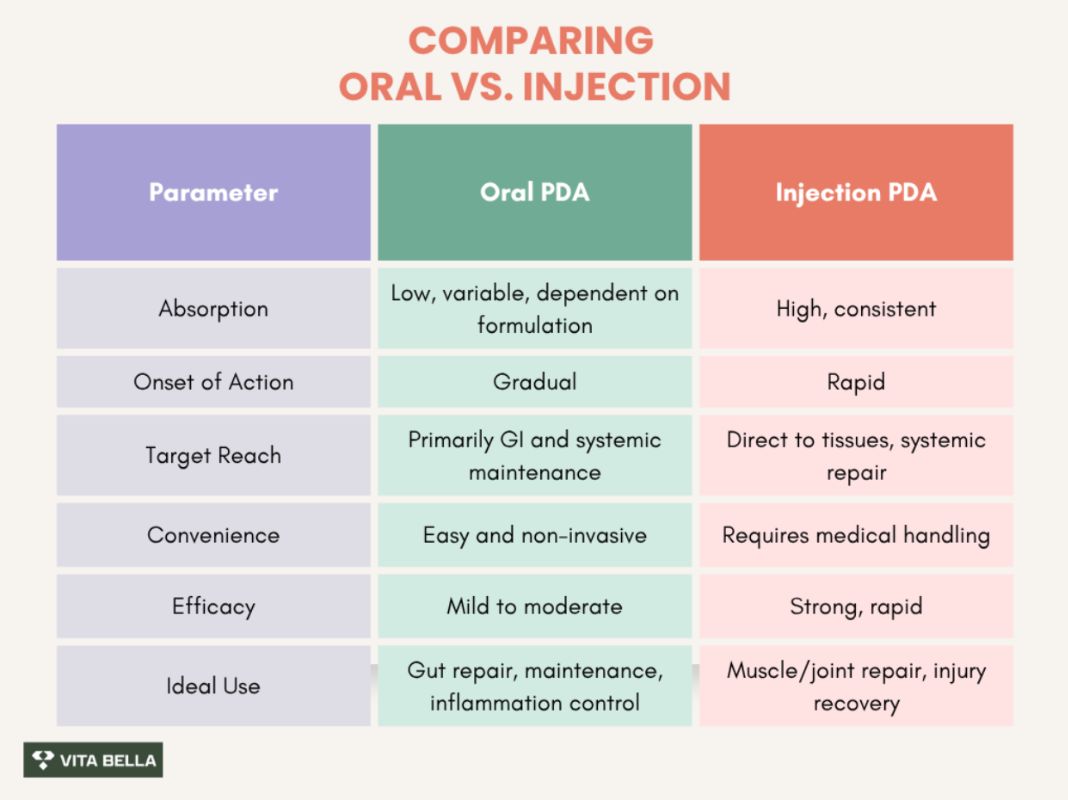
Both oral and injectable PDA show promise in promoting recovery, though for different reasons. Injections deliver consistent, potent effects ideal for acute injuries or rehabilitation, while oral delivery offers convenience and potential for ongoing maintenance and gut support.
Future clinical research will determine how these findings translate to human applications. Still, current data make one thing clear: PDA’s dual potential, systemic and localised potential, marks a significant step forward in regenerative health innovation.
Unlock Faster Recovery and Peak Performance with Vita Bella’s PDA
Slow recovery, stiffness, and fatigue shouldn’t keep you from living fully. Whether you’re rebuilding after strain or optimising your performance, Vita Bella’s Pentadeca Arginate (PDA) empowers your body to repair, strengthen, and move freely through both oral ease and injectable precision.
Experience faster healing, enhanced flexibility, and long-lasting relief as your body restores balance. With Vita Bella’s Pentadeca Arginate (PDA), every dose is a step toward renewed strength, improved mobility, and a life free from limits. Backed by advanced peptide science, Vita Bella’s PDA gives you the edge to recover stronger and perform at your peak every day.
FAQs
Does the injectable form of Pentadeca Arginate (PDA) work faster than the oral form?
Yes, injectable PDA delivers the compound directly into the bloodstream, allowing for faster absorption and higher bioavailability. This route bypasses digestive barriers, supporting quicker muscle and joint recovery. Oral PDA, while effective, typically shows slower results due to enzymatic breakdown during digestion.
Is oral Pentadeca Arginate (PDA) still effective for recovery and repair?
Yes, oral PDA may be less potent than injections but still provides measurable benefits, especially for gut health and maintenance. Preclinical evidence suggests oral peptides can promote localized tissue healing and inflammation control when properly formulated, making it a convenient, non-invasive option for long-term support.
Is Pentadeca Arginate (PDA) safe to use in both oral and injectable forms?
Yes, research on related peptides like BPC-157 shows a strong safety profile in both oral and injected applications. PDA shares similar structure and mechanisms, suggesting comparable safety when properly compounded. However, users should always consult medical professionals for personalized dosing and clinical supervision.
Can Pentadeca Arginate (PDA) help improve joint flexibility and muscle strength?
Yes, PDA promotes angiogenesis and cellular regeneration, helping muscles recover faster while reducing inflammation around joints. Users often report improved flexibility, less stiffness, and better endurance. Whether taken orally or via injection, PDA supports long-term mobility and enhances overall physical performance naturally.
References:
Vukojević, J., Milavić, M., Perović, D., Ilić, S., Čilić, A. Z., Đuran, N., Štrbe, S., Zoričić, Z., Filipčić, I., Brečić, P., Seiverth, S., & Sikiric, P. (2022). Pentadecapeptide BPC 157 and the central nervous system. Neural Regeneration Research, 17(3), 482–487. https://doi.org/10.4103/1673-5374.320969
Nicze, M., Borówka, M., Dec, A., Niemiec, A., Bułdak, Ł., & Okopień, B. (2024). The current and promising oral delivery methods for protein- and peptide-based drugs. International Journal of Molecular Sciences, 25(2), 815. https://doi.org/10.3390/ijms25020815
Muheem, A., Shakeel, F., Jahangir, S., Anwar, M., Mallick, N., Jain, G. K., Warsi, M. H., & Ahmad, F. J. (2016). A review on the strategies for oral delivery of proteins and peptides and their clinical perspectives. Saudi Pharmaceutical Journal, 24(4), 413–428. https://doi.org/10.1016/j.jsps.2014.04.001
DeFoor, M. T., & Dekker, T. J. (2025). Injectable therapeutic peptides—An adjunct to regenerative medicine and sports performance? Arthroscopy: The Journal of Arthroscopic & Related Surgery, 41(2), 150-152. https://doi.org/10.1016/S0749-8063(24)00667-4
Sikiric, P., Seiwerth, S., Rucman, R., Kolenc, D., Batelja Vuletic, L., Drmic, D., Grgic, T., Strbe, S., Zukanovic, G., Crvenkovic, D., Madzarac, G., Rukavina, I., Sucic, M., Baric, M., Starcevic, N., Krstonijevic, Z., Lovric Bencic, M., Filipcic, I., Stancic Rokotov, D., & Vlainic, J. (2016). Brain–gut axis and pentadecapeptide BPC 157: Theoretical and practical implications. Current Neuropharmacology, 14(8), 857–865. https://doi.org/10.2174/1570159X13666160502153022
McGuire, F. P., Martinez, R., Lenz, A., Skinner, L., Cushman, D. M., & et al. (2025). Regeneration or risk? A narrative review of BPC-157 for musculoskeletal healing. Current Reviews in Musculoskeletal Medicine, 18(4), 611-619. https://doi.org/10.1007/s12178-025-09990-7
QUICK SUMMARY:
Here are the key takeaways from the article, keeping it chill and easy to read:
PDA is the new buzzword for recovery: Pentadeca Arginate (PDA) is a hot peptide that's showing promise for helping your tissues, muscles, and joints bounce back faster.
How you take it matters a LOT: Seriously, swallowing a peptide (oral) is totally different from getting a shot (injection). This changes how much of the good stuff your body actually absorbs (bioavailability) and how fast it gets to work.
Oral PDA: Easy but less potent:
Pros: Super convenient and way easier for long-term use (better compliance).
Cons: Your stomach acid and enzymes can break down the peptide before it hits your bloodstream, meaning it's less consistently effective system-wide.
Good News: New tech like encapsulation is trying to make oral peptides as effective as injections! It's also good for ongoing maintenance and gut support.
Injectable PDA: Powerful and reliable:
Pros: Bypasses your entire digestive system to get straight into your blood. This means faster action and higher concentrations reaching the target tissues (like an injured joint). Great for acute injuries!
Cons: Less convenient for daily use, requires sterile handling, and, well, you have to stick yourself, which can be mildly uncomfortable.
BPC-157 is PDA's cousin: Since there aren't full human trials on PDA yet, the article points to BPC-157 (a similar peptide). Studies on BPC-157 show it's safe and really good at helping tissues heal and reducing inflammation, giving us good clues about PDA's potential.
How it helps you heal: These peptides promote healing by boosting angiogenesis (forming new blood vessels) and cellular regeneration. This is why users often feel improved flexibility, less stiffness, and better endurance.
The Bottom Line:
Need fast, potent results for an injury? Injection is probably the way to go.
Looking for easy, long-term support and gut health? Oral PDA is a convenient option.
Vita Bella has your back: They offer PDA in both oral (for ease) and injectable (for precision) forms to help you recover stronger and perform at your peak.