











Dragging through your days with low energy, poor focus, and fading motivation? For many men, these symptoms alongside decreased libido, mood swings, and gradual muscle loss signal low testosterone 1. Testosterone replacement therapy (TRT) 2 is a medical treatment designed to restore hormone levels and improve quality of life, often relieving fatigue, sexual dysfunction, and reduced strength.
TRT 3 is most beneficial for men with clinically confirmed hypogonadism, typically after two separate low testosterone readings. However, it may not be appropriate for men with specific comorbidities, such as prostate cancer or severe cardiovascular disease.
Your health story is unique, and so is our approach. Vita Bella provides safe, monitored TRT care designed to optimize results while protecting your long-term health. Take the step toward feeling your best with a partner you can trust
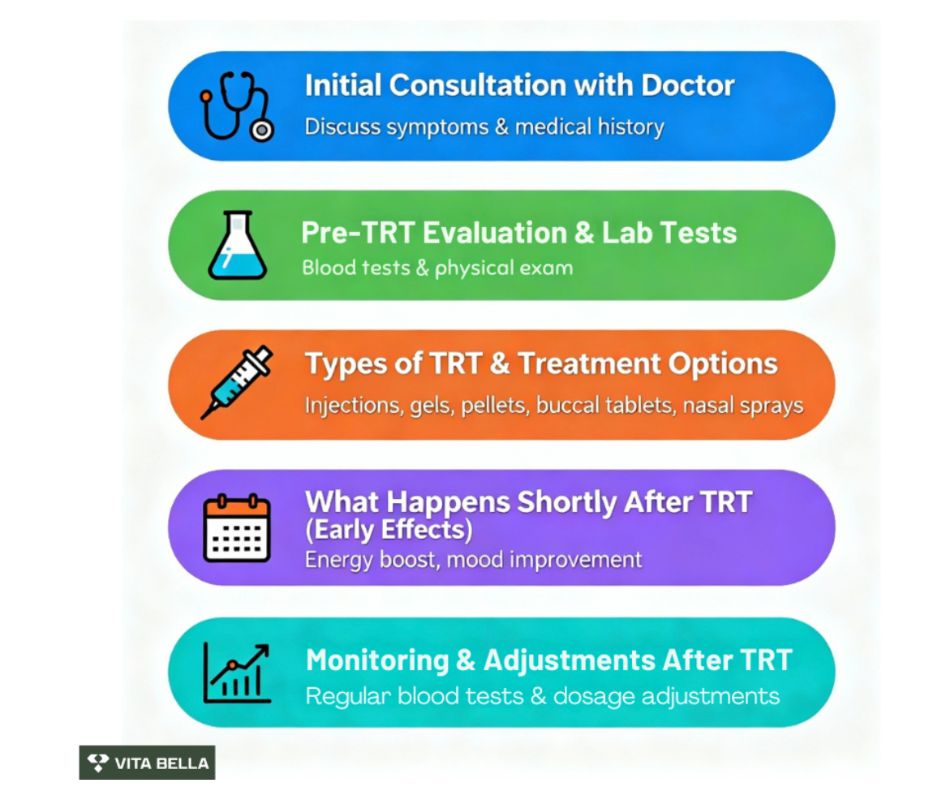
Initial Consultation with Doctor
During the initial consultation 4 for Testosterone Replacement Therapy (TRT), the physician conducts a comprehensive evaluation, including detailed medical history, physical examination, and laboratory testing to confirm low testosterone levels and assess symptoms of hypogonadism.
Discussions focus on the potential benefits, such as improved libido, mood, muscle mass, and bone density, alongside possible risks including cardiovascular events, erythrocytosis, or worsening prostate conditions.
TRT is initiated only when both clinical symptoms and confirmed low testosterone are present. The treatment plan is individualized, taking into account the patient's age, comorbidities, and preferences, with close monitoring of hormone levels 1 and safety parameters to optimize outcomes and minimize adverse effects.
Pre-TRT Evaluation & Lab tests
TRT is FDA-approved for men who have at least two documented low serum testosterone 3 levels in morning samples plus symptoms of hypogonadism such as low libido, decreased spontaneous erections, and shrinking testes.
Before starting TRT, doctors take a detailed medical history 3: they ask about symptoms such as low libido, fatigue, mood changes, muscle weakness; family history (prostate cancer, cardiovascular disease); and existing health conditions, including sleep apnea, liver/kidney issues, or hematologic disorders.
They also evaluate baseline lab tests, including total testosterone measured in morning samples and free testosterone, to confirm deficiency.
For men over ~40, PSA (prostate-specific antigen) is checked as part of prostate cancer risk screening before TRT is considered.
A baseline hematocrit is necessary to detect the risk of polycythemia (elevated red blood cell volume), and other labs frequently include liver and kidney function tests, a lipid profile, and, in some cases, hormone precursors such as LH, FSH, and prolactin.
Types of TRT & Treatment Options
The following treatments are commonly used for TRT.
TRT can be delivered via intramuscular (IM) injections 5 and creams, each with different pharmacokinetics and patient convenience profiles.
Injections (cypionate, enanthate, undecanoate) deliver high doses less frequently (every 1-4 weeks or longer), but they can cause peaks/troughs in testosterone levels, discomfort at injection sites, and require clinic visits.
Creams allow daily dosing, more stable testosterone levels, easier self-administration, but risk skin irritation and transfer to others, and tend to be costlier.
Enclomiphene is an oral selective estrogen receptor modulator (SERM) that stimulates the body’s own production of testosterone by increasing luteinizing hormone (LH) and follicle-stimulating hormone (FSH). Unlike traditional TRT, it helps maintain fertility and normal testicular function, making it an attractive option for men seeking to boost testosterone without suppressing natural sperm production.
Treatment choice 3 depends on individual factors like age, comorbidities, fertility concerns, and whether stable levels vs dosing convenience are priorities.
What Happens Shortly After You Start TRT?
Testosterone acts like a master key in the male body, turning on a host of physiological and psychological effects almost immediately after levels rise. Testosterone rapidly influences neurotransmitters 6 such as dopamine and serotonin, enhancing mood, motivation, and overall health.
Early effects may include improved focus, increased confidence, and reduced fatigue, which are usually noticeable within 2–4 weeks.
Expected Early Outcomes:
Improved Libido & Sexual Function: Enhancements in sexual interest and function are often noticeable within 3–6 weeks.
Mood & Energy Levels: Many men report increased energy and improved mood within 3–4 weeks.
Cognitive Function: Improvements in concentration and self-confidence can be observed after approximately 3 weeks.
Decreased Fatigue: Reduction in fatigue and listlessness is often noted after 1–6 weeks.
Monitoring & Adjustments after TRT
To ensure the efficacy and safety of TRT, regular monitoring is essential 7. Key parameters to assess include:
1- Testosterone Levels:
Measure total serum testosterone 2–4 weeks after initiating therapy to assess adequacy of dosing. Subsequent evaluations should occur at 3–6 months, then annually. The target range is typically 450–600 ng/dL.
2- Hematocrit (Hct):
Assess at baseline, then at 3 and 6 months, and annually thereafter. If Hct exceeds 54%, consider dose reduction or therapy interruption.
3- Prostate-Specific Antigen (PSA):
Obtain before initiating therapy, at 3 months, and then annually. An increase >1.4 ng/mL within a year warrants further evaluation.
4- Lipid Profile:
Evaluate at baseline, 3–6 months, and annually. Monitor for potential changes in cholesterol levels.
5- Digital Rectal Exam (DRE):
Perform before initiating therapy and annually thereafter, especially in men over 40 or with a family history of prostate cancer.
These assessments help identify potential adverse effects and guide therapeutic decisions. Dose adjustments are based on symptom response and laboratory results:
Follow up on Testosterone Levels:
If serum testosterone levels fall outside the target range (e.g., <350 ng/dL or >600 ng/dL), adjust the dose or frequency of administration. This may involve increasing or decreasing the dose, changing the formulation, or altering the administration schedule.
Vita Bella: Smarter TRT, Better Outcomes
Testosterone therapy isn’t just about injections; it’s about the right dose, at the right time, with the right monitoring.
Vita Bella specializes in ongoing TRT monitoring, comprehensive care with routine labs, symptom tracking, and ensuring your treatment adapts to your body’s needs. Get expert care that restores power while protecting your long-term health.
FAQs
1. Will I start testosterone therapy at my very first appointment?
Not usually. The first visit typically involves discussing symptoms, reviewing medical history, and ordering blood tests. Treatment usually begins only after results confirm low testosterone and it’s safe to proceed.
2. What tests are required before beginning TRT?
Doctors often check total and free testosterone levels, PSA (prostate-specific antigen), blood count, liver and kidney function, and sometimes hormone precursors. These help create a safe and personalized treatment plan.
3. How soon can I expect to feel results from TRT?
Some improvements like energy, mood, and libido may appear within a few weeks, while changes in muscle mass, bone density, and overall health may take several months.