








When it comes to recovering from sports injuries, rest and rehabilitation are commonly considered the main components of healing. However, there’s a crucial factor that many overlook: hormonal balance–particularly testosterone levels–along with peptides that support recovery. While rest plays an essential role in recovery, relying on it alone may not be enough to restore the body’s ability to heal and rebuild fully.
At Vita Bella, we understand that true recovery goes beyond just rest. To heal faster and stronger, you need a full-spectrum approach that includes optimizing your hormones and supporting tissue repair with advanced therapies. Our expert team combines testosterone optimization, peptide treatments, and personalized care to help you recover efficiently. Don’t settle for slow healing; choose Vita Bella for a smarter, faster recovery.
What is the Role of Testosterone in Recovery?
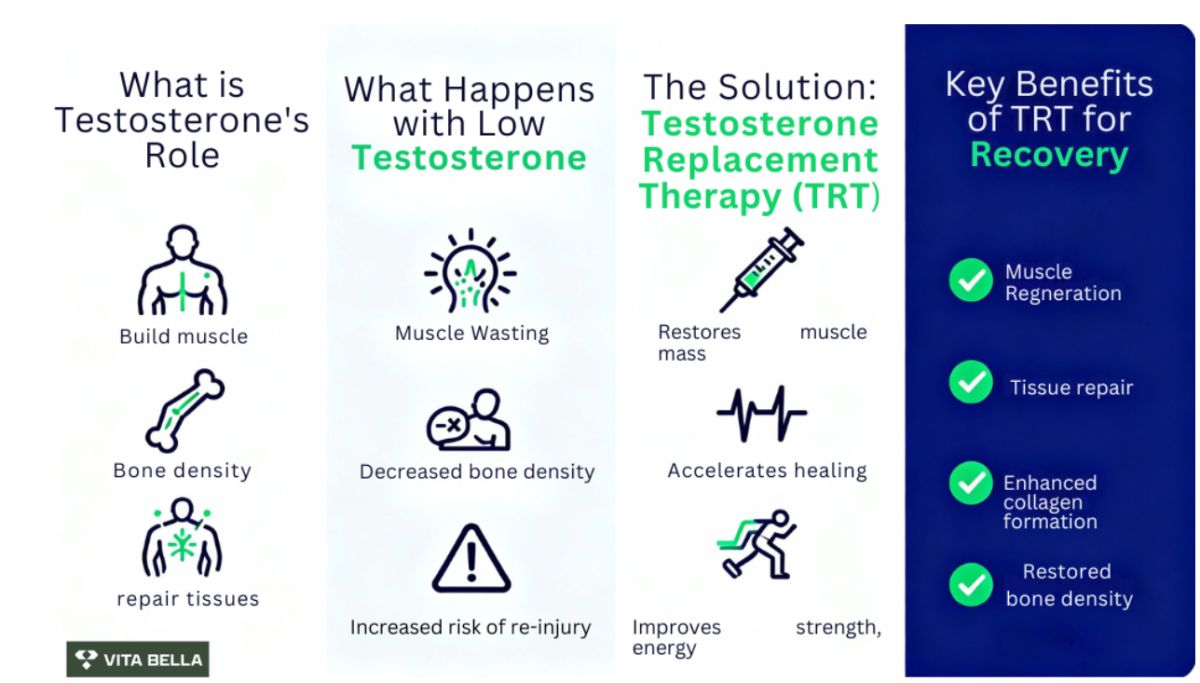
Testosterone is often associated with building muscle, but its role goes much deeper. It is a vital anabolic hormone, meaning it helps to build and repair tissues, including muscle fibers, cartilage, and bone. This makes it an essential factor in any recovery process. Without adequate testosterone, the body struggles to recover from both acute and chronic injuries.
1- Anabolic vs. Catabolic States:
When testosterone levels are low, the body moves from an anabolic (building) state to a catabolic (breaking down) state. In a catabolic state, the body struggles to rebuild muscle and tissues that are damaged during physical activity or injury. This state not only delays recovery but also makes the body more susceptible to further injury. High cortisol levels, often associated with stress, can further exacerbate this catabolic effect when testosterone is insufficient.
In a study 1 conducted in 2001, it was found that testosterone supplementation led to significant increases in lean body mass and muscle strength in men with low testosterone. This finding highlights the importance of maintaining testosterone levels, particularly when recovering from injury. Moreover, GnRH agonist and testosterone treatment cause changes in circulating testosterone levels, which are linked to testosterone dose.
2- Low T and Muscle Recovery:
Without adequate testosterone, muscle tissue doesn't repair itself efficiently. In fact, low testosterone has been linked to increased muscle wasting, especially in individuals who have experienced significant injury. This further delays recovery, leaving athletes stuck in a cycle where they cannot fully regain their strength and performance. Testosterone supports protein synthesis, a critical process for muscle repair and growth. When the body lacks this support, healing is slow and incomplete.
How Does Low Testosterone Affect Recovery?
According to research 2, the problems associated with low testosterone levels (such as sarcopenia or decreased lean mass; an increased risk of developing osteoporosis; anemia; skin thinning; poor wound healing; and weakness) demonstrate the significance of testosterone. Low testosterone can derail recovery in several other key ways:
Impaired Muscle Regeneration: Testosterone helps the body repair muscles after intense exercise or injury. Without it, muscle fibers take longer to rebuild, and the process may be incomplete. This increases the risk of future injury and prolongs the time it takes to return to peak performance.
Decreased Bone Density: Testosterone is involved in maintaining bone density. During recovery from an injury, strong bones are essential for supporting muscle repair. Low testosterone can slow bone healing, making fractures take longer to mend and increasing the likelihood of future bone injuries.
Delayed Tissue Repair: Testosterone is essential in collagen synthesis, which plays a significant role in repairing tissues like ligaments and tendons. Without sufficient testosterone, the healing of these tissues can be significantly delayed, leaving athletes vulnerable to re-injury.
How Should I Integrate Testosterone into My Recovery Plan?
To overcome the catabolic effects of low testosterone, it’s essential to consider strategies that help restore optimal testosterone levels. Rest and rehabilitation are necessary, but testosterone support may be the missing link for more efficient recovery. Optimizing testosterone levels helps restore the anabolic environment necessary for effective healing.
1- Testosterone Replacement Therapy (TRT)
For athletes or individuals with clinically low testosterone levels, TRT can be an effective solution to bring the body back to an anabolic state. Restoring testosterone can help accelerate muscle repair, improve energy levels, and reduce the risk of injury. Studies show that TRT significantly improves muscle mass and strength, providing essential support during recovery.
A study 3 published in 2017 found that three years of testosterone replacement therapy was linked to slight increases in muscle power, chest press strength, unloaded and loaded stair climbing power, and lean mass of the body. While these findings are encouraging, the degree of change in the metrics of lean mass, physical function, and muscular performance is even in older men.
What Is the Role of Peptides in Supporting Healing?
Peptides play a crucial role in supporting healing by stimulating growth hormone (GH) secretion and promoting tissue repair. Peptides like sermorelin and CJC-1295 enhance the body’s natural ability to regenerate muscle, tendons, and ligaments. Additionally, peptides like BPC-157 promote angiogenesis, helping build new blood vessels and accelerating the delivery of nutrients to injured areas, speeding up the healing process. Key peptides include:
1- Sermorelin and CJC-1295
Sermorelin and CJC-1295 are peptides that can help with the growth hormone (GH) secretion, indirectly supporting tissue repair. These peptides stimulate the pituitary gland to release more growth hormone, which is essential for muscle repair, fat metabolism, and recovery. By increasing GH levels, you can improve healing and recovery from injuries.
A study 5 conducted in children shows that the smallest synthetic peptide with complete biological action of human growth hormone-releasing hormone (GHRH) is sermorelin, a 29-amino acid counterpart of GHRH. The release of growth hormone from the anterior pituitary is selectively stimulated by intravenous and subcutaneous sermorelin. Some prepubertal children with idiopathic growth hormone deficiency may benefit from subcutaneous sermorelin 30 microg/kg bodyweight once a day, as it promotes growth.
2- BPC-157
BPC-157, a peptide known for its healing properties, can assist with tissue repair by promoting angiogenesis, the process of forming new blood vessels. New blood vessels are critical in the recovery process, as they supply oxygen and nutrients to the injured area, helping it heal more quickly.
Research 4 shows that in models of tendon rupture, ligament rips, muscle tears, and fractures indicates that BPC-157 facilitates structural, biomechanical, and functional healing. BPC-157 is processed in the liver, eliminated in the urine, and detectable by mass spectrometry techniques for up to four days, just like other peptide hormones. BPC-157 regulates angiogenesis, anti-inflammation, cell growth, proliferation, and survival.
Get Back to Peak Performance and Personalized Healing Solutions with Vita Bella
Just resting isn’t enough when your body lacks the hormones needed for muscle repair. Low testosterone can lead to a slower, incomplete recovery process, leaving you at risk for re-injury. The solution is a full-spectrum recovery approach that includes both hormonal support and advanced peptides. By integrating testosterone optimization with peptide therapy, your recovery process can be significantly accelerated.
At Vita Bella, we specialize in hormone optimization for faster healing. Our recovery plans combine TRT, Sermorelin, and BPC-157 for enhanced tissue repair and faster recovery. We help you rebuild muscle, strengthen your bones, and reduce recovery time. Start your journey with Vita Bella for a more effective and faster recovery.
FAQs
Can low testosterone slow down recovery from sports injuries?
Yes, low testosterone can impair muscle regeneration, bone density, and tissue repair, all of which are crucial for recovering from sports injuries. Without sufficient testosterone, the body struggles to heal efficiently, leading to prolonged recovery times and a higher risk of re-injury. Optimizing testosterone levels can accelerate the healing process.
Is testosterone replacement therapy (TRT) beneficial for injury recovery?
Yes, TRT helps restore anabolic (building) processes in the body, supporting muscle repair and tissue regeneration. Clinical studies show that TRT can improve muscle mass, strength, and recovery outcomes, particularly for individuals with low testosterone. This therapy is especially beneficial when recovering from injuries that require significant tissue repair.
Do peptides like sermorelin and CJC-1295 help speed up injury recovery?
Yes, peptides like sermorelin and CJC-1295 stimulate growth hormone secretion, promoting tissue repair and recovery. These peptides improve muscle regeneration, collagen formation, and fat metabolism, which can significantly enhance recovery after sports injuries. Regular use of these peptides accelerates the healing process by supporting the body’s natural repair mechanisms.
Is rest alone enough for full recovery after a sports injury?
No, while rest is essential for injury recovery, it’s not enough on its own. Testosterone optimization, hormone balance, and the integration of peptides like BPC-157 can significantly enhance the healing process. These interventions promote muscle and tissue repair, reduce recovery time, and improve overall recovery outcomes.
References:
Bhasin, S., Woodhouse, L., Casaburi, R., Singh, A. B., Bhasin, D., Berman, N., Chen, X., Yarasheski, K. E., Magliano, L., Dzekov, C., Dzekov, J., Bross, R., Phillips, J., Sinha‑Hikim, I., Shen, R., & Storer, T. W. (2001). Testosterone dose‑response relationships in healthy young men. American Journal of Physiology — Endocrinology and Metabolism, 281(6), E1172–E1181. https://doi.org/10.1152/ajpendo.2001.281.6.e1172
Demling, R. H. (2007). The use of anabolic agents in catabolic states. Journal of Burns and Wounds, 6, e2. https://www.ncbi.nlm.nih.gov/pmc/articles/PMC1804253/
Storer, T. W., Basaria, S., Traustadottir, T., Harman, S. M., Pencina, K., Li, Z., Travison, T. G., Miciek, R., Tsitouras, P., Hally, K., Huang, G., & Bhasin, S. (2017). Effects of testosterone supplementation for 3 years on muscle performance and physical function in older men. The Journal of Clinical Endocrinology & Metabolism, 102(2), 583–593. https://doi.org/10.1210/jc.2016-2771
Vasireddi, N., Hahamyan, H., Salata, M. J., Karns, M., Calcei, J. G., Voos, J. E., & Apostolakos, J. M. (2025). Emerging use of BPC‑157 in orthopaedic sports medicine: A systematic review. HSS Journal®, 21(4), 485–495. https://doi.org/10.1177/15563316251355551
Prakash, A., & Goa, K. L. (1999). Sermorelin: a review of its use in the diagnosis and treatment of children with idiopathic growth hormone deficiency. BioDrugs, 12(2), 139–157. https://link.springer.com/content/pdf/10.2165/00063030-199912020-00007.pdf